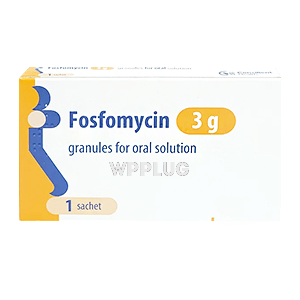
Fosfomycin
| Product dosage: 3g | |||
|---|---|---|---|
| Package (num) | Per sachet | Price | Buy |
| 1 | $42.00 | $42.00 (0%) | 🛒 Add to cart |
| 2 | $37.50 | $84.00 $75.00 (11%) | 🛒 Add to cart |
| 3 | $35.67 | $126.00 $107.00 (15%) | 🛒 Add to cart |
| 4 | $35.00 | $168.00 $140.00 (17%) | 🛒 Add to cart |
| 5 | $34.60 | $210.00 $173.00 (18%) | 🛒 Add to cart |
| 6 | $34.17 | $252.00 $205.00 (19%) | 🛒 Add to cart |
| 7 | $34.00 | $294.00 $238.00 (19%) | 🛒 Add to cart |
| 8 | $33.88 | $336.00 $271.00 (19%) | 🛒 Add to cart |
| 9 | $33.67 | $378.00 $303.00 (20%) | 🛒 Add to cart |
| 10 | $33.60
Best per sachet | $420.00 $336.00 (20%) | 🛒 Add to cart |
Synonyms | |||
Fosfomycin: Effective Single-Dose Treatment for Uncomplicated UTIs
Fosfomycin tromethamine is a broad-spectrum bactericidal antibiotic indicated primarily for the treatment of uncomplicated urinary tract infections (UTIs) caused by susceptible strains of designated microorganisms. It represents a valuable therapeutic option in an era of increasing antimicrobial resistance, offering a convenient single-dose oral regimen that enhances patient compliance and reduces the risk of incomplete treatment courses. Its unique mechanism of action and favorable pharmacokinetic profile make it a first-line consideration for acute cystitis in non-pregnant adult women.
Features
- Chemical structure: (1R,2S)-1,2-epoxypropylphosphonic acid tromethamine salt
- Mechanism: Irreversible inhibition of bacterial cell wall synthesis by blocking phosphoenolpyruvate synthetase
- Spectrum: Broad activity against both Gram-positive and Gram-negative uropathogens
- Administration: Oral granule formulation for reconstitution
- Bioavailability: Approximately 34-41% in fasting state, with higher concentrations achieved in urine
- Elimination: Primarily renal excretion with minimal metabolism
- Pregnancy category: B
Benefits
- Single-dose administration ensures complete treatment course and superior adherence
- Maintains efficacy against many multidrug-resistant pathogens including ESBL-producing Enterobacteriaceae
- Low propensity for cross-resistance with other antibiotic classes due to unique mechanism
- Favorable safety profile with minimal systemic side effects
- Rapid urinary concentration achieving bactericidal levels within 2-4 hours
- Minimal disruption to gastrointestinal flora compared to prolonged antibiotic courses
Common use
Fosfomycin tromethamine is primarily indicated for the treatment of uncomplicated urinary tract infections (acute cystitis) in women caused by susceptible strains of Escherichia coli and Enterococcus faecalis. It may also be used off-label for complicated UTIs when susceptibility is confirmed, though typically in multiple-dose regimens. The medication is particularly valuable in cases where first-line agents are contraindicated or when resistance patterns favor its use. Clinical guidelines from IDSA and EUCAST support its role as an alternative first-line agent for uncomplicated UTIs.
Dosage and direction
The standard adult dosage for uncomplicated UTIs is a single 3-gram sachet dissolved in ½ glass (4 ounces) of cold water. Administration should occur immediately after reconstitution, preferably on an empty stomach (at least 2 hours before or after meals) to optimize absorption. For patients with renal impairment (creatinine clearance <50 mL/min), dosage adjustment may be necessary, though specific guidelines vary. No pediatric dosing has been established. The single-dose regimen should not be repeated without medical consultation.
Precautions
Patients should be advised that fosfomycin may cause dizziness; caution should be exercised when operating machinery or driving. Those with history of asthma or severe allergic reactions should use with caution. Monitoring of renal function is recommended in patients with pre-existing renal impairment. While the single-dose regimen minimizes risks, prolonged use may lead to superinfection including pseudomembranous colitis. Patients should complete the full course as prescribed despite symptom resolution to prevent resistance development.
Contraindications
Hypersensitivity to fosfomycin or any component of the formulation constitutes an absolute contraindication. The medication is not recommended for patients with severe renal impairment (creatinine clearance <10 mL/min) without careful benefit-risk assessment. It should not be used for systemic infections outside the urinary tract due to limited tissue penetration. Concomitant use with metoclopramide is contraindicated as it may decrease urinary concentration of fosfomycin.
Possible side effect
The most commonly reported adverse reactions (>1%) include diarrhea (9.1%), nausea (4.3%), headache (3.9%), dizziness (2.1%), and vaginitis (2.8%). Less frequent side effects may include dyspepsia, abdominal pain, rhinitis, pharyngitis, back pain, and rash. Serious but rare adverse effects include pseudomembranous colitis, severe hypersensitivity reactions, and hematologic abnormalities. Most side effects are mild to moderate and self-limiting given the single-dose nature of treatment.
Drug interaction
Metoclopramide significantly decreases urinary concentration of fosfomycin and should be avoided. Cimetidine may increase serum concentrations of fosfomycin through potential renal transport competition. No clinically significant interactions have been documented with oral contraceptives, warfarin, or most commonly prescribed medications. However, as with all antibiotics, fosfomycin may reduce the efficacy of oral typhoid vaccine.
Missed dose
Given the single-dose regimen, the concept of a “missed dose” does not typically apply. If a patient fails to take the medication as scheduled, they should administer it as soon as possible unless it is接近 the time for the next scheduled dose. For regimens extending beyond a single dose (off-label use), if a dose is missed, it should be taken as soon as remembered unless it is almost time for the next dose, in which case the missed dose should be skipped.
Overdose
No specific antidote exists for fosfomycin overdose. Symptoms may include gastrointestinal distress (nausea, vomiting, diarrhea) and potential electrolyte imbalances. Management should be supportive and symptomatic, with maintenance of hydration and electrolyte balance. Hemodialysis may remove fosfomycin in cases of significant overdose, particularly in patients with renal impairment. The single-dose packaging minimizes overdose risk.
Storage
Store at controlled room temperature (20-25°C or 68-77°F). Keep the sachet in the original package until ready to use to protect from moisture. Once reconstituted, the solution should be consumed immediately and not stored for later use. Keep out of reach of children and pets. Do not use after the expiration date printed on the packaging.
Disclaimer
This information is provided for educational purposes only and does not constitute medical advice. Fosfomycin is a prescription medication that should be used only under the supervision of a qualified healthcare professional. The prescribing physician should be consulted for diagnosis and treatment decisions. Individual response to medication may vary, and not all side effects or interactions are listed here.
Reviews
Clinical studies demonstrate efficacy rates of 70-90% for uncomplicated UTIs caused by susceptible organisms. The single-dose convenience receives high patient satisfaction scores in post-marketing surveys. Infectious disease specialists appreciate its role in antimicrobial stewardship programs due to its narrow spectrum and low resistance potential. Some reviews note the granular formulation’s taste as a minor drawback, though this is offset by the single administration requirement.